
Our complete Umrah guide takes you through each step of how to perform Umrah, including the intention, rituals to clothes and duas so that you or your loved one can be ready to start this blessed journey with confidence and devotion.
Umrah, One of the Significant Holy Pilgrimages
There are two significant holy pilgrimages to the city of Makkah that are spiritually valuable to Muslims. The most significant pilgrimage is known as the Hajj and is compulsory for all Muslims who can afford to do so and is only held during a particular time of the year. The other significant pilgrimage for Muslims is called Umrah.
What is Umrah?
Umrah, in Arabic, comes from the word i'timar, which means "to visit". In Islamic terms, Umrah refers to visiting the Holy Kaaba in Masjid al-Haram to perform a sacred pilgrimage that includes specific rituals and it can be carried out almost any time throughout the year. Although Umrah is not obligatory but it is highly recommended and brings countless spiritual rewards. Umrah lasts only a few hours.
When a person performs Umrah, his soul becomes peaceful, his heart becomes clear and he comes closer to Allah Almighty. Millions of people from all around the world go for Umrah every year to seek forgiveness from Allah Almighty, to purify their intentions, to cleanse all of their past sins and come back to normal life after being spiritually uplifted.
The Pillars of Umrah
To simplify how to do Umrah, just remember these four essential pillars:
- Ihram: Entering the sacred state of worship
- Tawaf: Circling the Holy Kaaba seven times
- Sa'ee: Walking between the hills of Safa and Marwah
- Halq/Taqsir: Shaving or trimming the hair to end Umrah Each step carries profound spiritual meanings. Let’s break them down one by one for better understanding.
Step 1: Entering the State of Ihram (State of Purity)
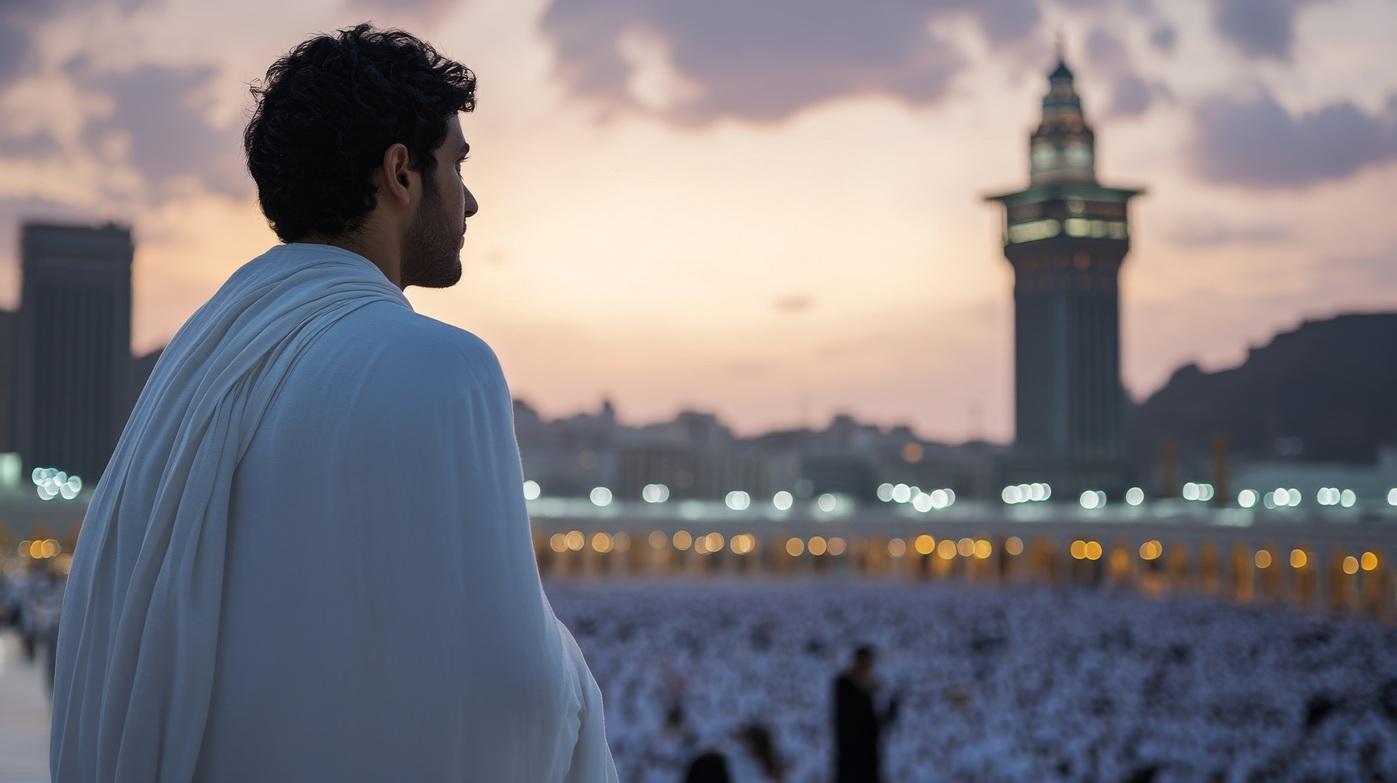
Pilgrims must wear an Ihram before crossing the boundaries of Makkah that are known as the Miqat. Men will wear two white, seamless and unstitched cloths and women will wear something loose, modest, and simple. Ihram isn't just a white cloth. It's a state of purification, mentally and physically. When you claim your intention (Niyyah) and say the Talbiyah then the journey of Umrah starts and you will officially become a Muhrim (a person in the state of Ihram). Entering the Ihram brings a wave of equality. No fancy clothes, no status symbols. Whether you’re a millionaire or a farmer, you are all equal and all that matters here is your sincere intentions to please Allah Almighty.
Ihram for Men and Women
Umrah Clothes for Men:
• Two unstitched white cotton clothes, one wrapped around the waist, the other draped over the shoulder.
• No underwear, socks or stitched garments.
Umrah Clothes for Women:
• Modest dress that fully covers the body (black or white abaya preferred).
• Hijab covering the hair, but not the face and doesn’t attract attention.
• Stitching is allowed in women’s Ihram.
Restrictions While in Ihram
While in Ihram, several things become forbidden:
• No cutting hair or nails
• No use of perfumes or scented soaps
• No marital relations
• No arguments, foul language, or fighting
• No hunting, killing animals, or harming plants
The purpose of forbidding Muslims from these things is that Ihram is all about humility, self-control, and focusing on your worship and staying away from worldly attractions.
Make the Niyyah
Before crossing one of the Miqats (specific geographic entry points), you must:
1. Take a full shower (ghusl) or at least perform wudhu.
2. Wear your Ihram garments.
3. Pray two rakahs of Salah with the intention of Ihram.
4. Verbally declare your Niyyah (intention), such as: “LabbaykAllahumma Umrah” (O Allah, I am here to perform Umrah.)
Dua for Entering Ihram:
Narrated by Abdullah ibn Umar (RA)
“Whenever the Prophet intended to perform Hajj or Umrah, he used to say:
‘Labbayk Allahumma Umrah wa Hajj’ (Here I am, O Allah, [to perform] Umrah.)
Talbiyah: The Official Start of Umrah
After making sincere intention (Niyyah), start reciting the Talbiyah to declare your intention aloud:
Labbayk Allahumma Labbayk. Labbayk la sharika laka Labbayk. Innal-hamda wan-ni‘mata laka wal-mulk. La sharika lak.
(Here I am, O Allah, here I am. Here I am, you have no partner, here I am. Surely all praise, blessings, and dominion are Yours. You have no partner.) Sahih Muslim – Hadith 1184
Step 2: Performing Tawaf Around the Holy Kaaba
This is how to start Tawaf Al-Umrah (Circling the Kaaba).
Once you reach Masjid al-Haram, you will begin the Tawaf by facing the Black Stone (Hajr al-Aswad), saying “Bismillah Allahu Akbar”, and then you will start walking seven times around the Kaaba, in an anti-clockwise direction.
Each circle gives you time to reflect. Some pilgrims recite duas, others just whisper to Allah Almighty from their hearts. There’s no one “right” way to feel here. You might be overwhelmed, quiet, or just smiling through tears. That’s all okay. Let the emotion come.
Sunnah Practices During Tawaf (Raml, Idtiba)
For men, two specific Sunnahs apply during Tawaf:
• Idtiba: Uncover the right shoulder by placing the Ihram under the right arm and over the left shoulder.
• Raml: In the first three rounds, walk briskly with small, energetic steps. The remaining four should be at a regular pace.
Duas for Umrah During Tawaf
Performing Umrah isn’t just a ritual. It’s a time to reconnect, reset your soul, and ask for forgiveness like never before.
You can:
• Recite verses from the Quran
• Make your own heartfelt supplications
• Or repeat this Dua
“Rabbana aatina fid-dunya hasanah wa fil-akhirati hasanah wa qina 'adhaban-naar” (Our Lord, grant us goodness in this world and goodness in the Hereafter, and protect us from the punishment of the Fire.)
(Quran 2:201)
Important Things To Consider While Doing Tawaf:
• You must recite the Talbiyah at least once after making your intention for Umrah. Failure to do so will result in an invalid Umrah.
• To make an intention (verbally or not).
• To be in a state of wudhu and free of anything that requires ghusl, e.g. menstruation.
• To conceal the awrah.
• To avoid the Hatim (the semi-circle area outside the Kaaba).
• To perform seven circuits.
• To perform two rakahs of salah after the Tawaf.
Completing Tawaf and Performing Salah Al-Tawaf
After completing seven rounds, head to Maqam Ibrahim (the station of Prophet Ibrahim AS) and perform two rakahs of Salah. If the area is too crowded, perform it anywhere in the mosque. Then proceed to drink Zamzam water, which brings us to the next step.
Step 3: Drinking Zamzam Water
Spiritual Significance of Zamzam
Zamzam isn’t just like any water. It’s a divine gift from Allah Almighty, discovered by Hajar (RA), the mother of Ismail (AS).
The Prophet Muhammad (PBUH) said:
"The best water on the face of the earth is Zamzam water. In it is food for nourishment and a cure for illness." Sahih al-Jami’ (Hadith 3302)
The Prophet Muhammad (PBUH) called it
“a cure for every illness and a nourishment for the soul.”
It’s believed that the intentions you make while drinking Zamzam are accepted, so drink generously and make dua.
Duas After Drinking Zamzam
Before drinking, face the Kaaba, say Bismillah, and make a dua from your heart and then drink as much as you need. You can also recite the prophetic supplication:
Allahumma inni as’aluka ‘ilman nafi’an, wa rizqan wasi’an, wa ‘amalan mutaqabbalan, wa shifa’an min kulli daa’.
(O Allah, I ask You for beneficial knowledge, abundant provision, accepted deeds, and healing from every disease.)
Step 4: Performing Sa'ee Between Safa and Marwah
Meaning and Importance of Sa’ee
After Tawaf and drinking Zamzam water, go to Safa hill to proceed with Saee or walk between Safa and Marwah Hills seven times.
The significance of Saee is to honor the great determination of Hajar (RA) who had to run between the Safa and Marwah mountains 7 times in search of water for her infant son, Ismail (AS). Allah Almighty loved her effort and hope to the extent that He has turned this act into a pillar of Umrah.
How to Perform Sa’ee Step-by-Step
1. Begin at Safa Hill. Face the Kaaba, raise your hands.
2. Make dua, praise Allah Almighty, and begin walking toward Marwah.
3. Between two green markers, men should jog lightly. Women continue walking normally.
4. On reaching Marwah, stop, raise your hands again, praise Allah Almighty, and make dua.
5. Repeat this until your 7th lap ends at Marwah.
Duas and Supplications During Sa’ee
There are no required duas, but this is a golden time to ask Allah Almighty for everything your heart desires. You can:
• Send Salawat on the Prophet Muhammad (PBUH)
• Repeat La ilaha illallah, SubhanAllah, Astaghfirullah
• Make heartfelt, raw duas in your native language
• Or can recite this dua during Sa’ee
“Inna as-Safa wal-Marwata min sha'airillah”
(Indeed, Safa and Marwah are among the symbols of Allah.)
(Quran 2:158)
Step 5: Halq or Taqsir
What’s the Difference Between Halq and Taqsir?
After completing Sa’ee, it’s time for Halq (shaving the head) or Taqsir (trimming the hair), an important act to exit Ihram.
• Halq: Preferred for men, total shaving of the head.
• Taqsir: Shortening of hair from all over the head (minimum fingertip length).
For women, only Taqsir is allowed. Cut about 1 inch from the ends of your hair.
Hair Cutting Rules for Men and Women
• Use clean, hygienic tools.
• Get your hair cut in the designated barber zones around Haram.
• Make sure hair is taken evenly from all sides.
This final step symbolizes humility, letting go of vanity, and rebirth into a cleaner, purified state.
Step 6: Concluding Your Umrah
Leaving Ihram and Final Prayers
Once you've performed Halq or Taqsir, you are now out of the state of Ihram and you have completed the sacred journey of Umrah.
Gratitude and Reflection
Umrah is a chance to start anew. Like a soul reborn, you return to your regular life cleansed of sins.
Now is the time to:
• Forgive others
• Leave behind bad habits
• Implement the Sunnah of Prophet Muhammad (PBUH)
• Stick to salah and Qur’an recitation
• Serve your community with humility and charity
Umrah isn’t the end. It’s the beginning of a deeper connection with Allah Almighty.
What to Wear for Umrah: Clothes and Essentials
Ensuring you are well prepared for Umrah with all the essentials can make the world of difference to your experience. By not following rules and regulations, one runs the risk of their Umrah becoming invalid. One important point to note is that while in the state of Ihram, no scented or perfumed items can be used, such as lotions or perfumes.
Essentials to Pack:
Your focus should be on Modesty and comfort while packing things for Umrah. Here's what you should pack
• 2 sets of Ihram clothes
• Ihram belt/pouch
• Travel-sized toiletries (unscented)
• Prayer mat and tasbih
• A small Quran or a dua book
• Refillable water bottle
• Flip-flops or soft sandals
• Basic medicine
• A light bag for carrying essentials
• Snacks (nuts, dates, energy bars)
• Identification and documents in a waterproof holder
Keep your focus on the journey, not the luggage. By preparing appropriately, pilgrims can focus on their worship without distraction.
Essential Rules and Conditions of Umrah
1. Being a Muslim
Only Muslims are allowed to perform Umrah. Non-Muslims are strictly prohibited from entering the holy sites in Makkah and Madinah.
2. Being Sane (Aaqil)
The person must be of sound mind. If someone is mentally incapacitated, Umrah is not obligatory.
3. Being Mature (Baaligh)
A child can perform Umrah, and it will be rewarded, but it won’t count as their obligatory Umrah. Once someone becomes baaligh (mature), Umrah becomes personally obligatory (fardh) after reaching maturity, if the person meets other conditions.
4. Financial and Physical Ability
The individual must be physically and financially capable:
• Able to travel without causing hardship.
• Have sufficient funds for travel and expenses.
• Must leave behind enough for dependents.
5. Mahram for Women
A woman must be accompanied by a mahram, an unmarriageable male relative or her husband. ( This can be changed according to the law.)
How Long Does Umrah Take?
Here’s a breakdown of the average duration of Umrah rituals:
| Ritual | Approximate Time |
| Tawaf | 1–2 hours |
| Salah after Tawaf | 15–30 minutes |
| Zamzam + Short Rest | 15 minutes |
| Sa’ee | 1.5–2 hours |
| Hair Cutting | 15 minutes |
In total, a well-paced Umrah takes around 3.5 to 5 hours. During peak seasons (Ramadan, December holidays), it may take longer due to crowds.
Supporting Others on Their Umrah Journey
Thousands of Muslims around the world dream of visiting Mecca but poverty and financial struggles stand in their way. Begin your journey of Umrah and help others take theirs. Sponsor someone’s Umrah journey today through Al Mustafa Welfare Trust. Your contribution can be the answer to someone’s prayer.