Waqf in Islam refers to a type of "Islamic charitable endowment". Waqf is an Arabic term; it means "to cease", or "to restrain". Waqf meaning is "freezing the use of an asset or property" by donating it for the benefit of community welfare or spiritual rewards and dedicating it for the sake of Allah Almighty permanently. It plays an important role in the maintenance of a perpetual charity contribution to education, health and social infrastructure. This charity is an "Ongoing Charity" (Sadaqah jariyah), which will continue to reward donor even after he or she has passed away.
Endowment: The asset is permanently donated to a charitable/religious purpose. Perpetuity: The waqf is meant to last forever, and it cannot be revoked unless destroyed or invalidated. Charitable Purpose: It should serve the interests of the underprivileged ethically and morally. No Ownership: The asset belongs to Allah Almighty; only benefits are used by people in need.
The Quran highlights the importance of sustaining communal welfare, as seen in verses like: "You will never achieve righteousness until you donate some of what you cherish. And whatever you give is certainly well known to Allah." (Quran 3:92) The Prophet Muhammad (Peace Be Upon Him) also advocated for Waqf. He said: "When a man dies, his deeds come to an end except for three: Sadaqah Jariyah (a continuous charity), knowledge which is beneficial, or a virtuous descendant who prays for him." (Riyad as-Salihin 1383, Book 12, Hadith 8) These teachings explain the enduring nature of Waqf as a means to achieve both spiritual reward and societal benefit.
It starts with Prophet Muhammad (PBUH) himself. Our beloved Prophet Hazrat Muhammad (PBUH) is the founder of waqf because he presented it as an important aspect of Islamic civilization. The earliest recorded waqf was a well in Medina, which was bought by Uthman ibn Affan (RA) and given to the people. This action became a precedent for generations of Muslims.
Waqf has a rich and inspiring history. In the long term, the waqf has become one of the pillars of the Islamic Civilization. Schools (madrasas), libraries, hospitals, caravanserais and soup kitchens were endowed with waqfs in the time of the Umayyads and Abbasids. The Al-Azhar University, in Cairo, is one of the ancient Islamic universities, sustained by waqf for more than 1,000 years. Suleymaniye in Istanbul: a civic multi-purpose centre, which was completely funded by waqf. Waqf Boards in India: These are colonial institutions still running in India because of waqf. .
There are 3 main types of waqf in Quran including charitable waqf, family waqf, and public welfare waqf and each is established with a specific purpose to address various needs and specific groups of needy people.
This is created to support your loved ones, including children, spouse, or relatives. Any extra income beyond their needs is directed toward public welfare. This balances familial responsibility with wider ethical duty. Over time, family waqfs evolve into public waqfs once the family line ends or voluntarily transitions.
This is perhaps the most common type: dedicated entirely to public welfare. It funds mosques, schools, healthcare clinics, orphanages, and more. A waqf like this continues to benefit society, often for centuries. Some still active waqfs today were founded in the early Islamic centuries.
This supports the broader community. For example, parks, libraries, bridges, or clean water wells. They're open to all, regardless of religion or background. This type of waqf reflects Islam's inclusive philosophy and commitment to social good.
Waqf is more than charity; it's building lasting value in society. There are many religious, social, and economic benefits of waqf including Spiritual Benefits of Waqf
Social Impact
Economic Growth • Jobs created for administration, maintenance, teaching and medical staff. • Some institutions funded by Waqf become financial pillars in communities. • Reduces poverty sustainably
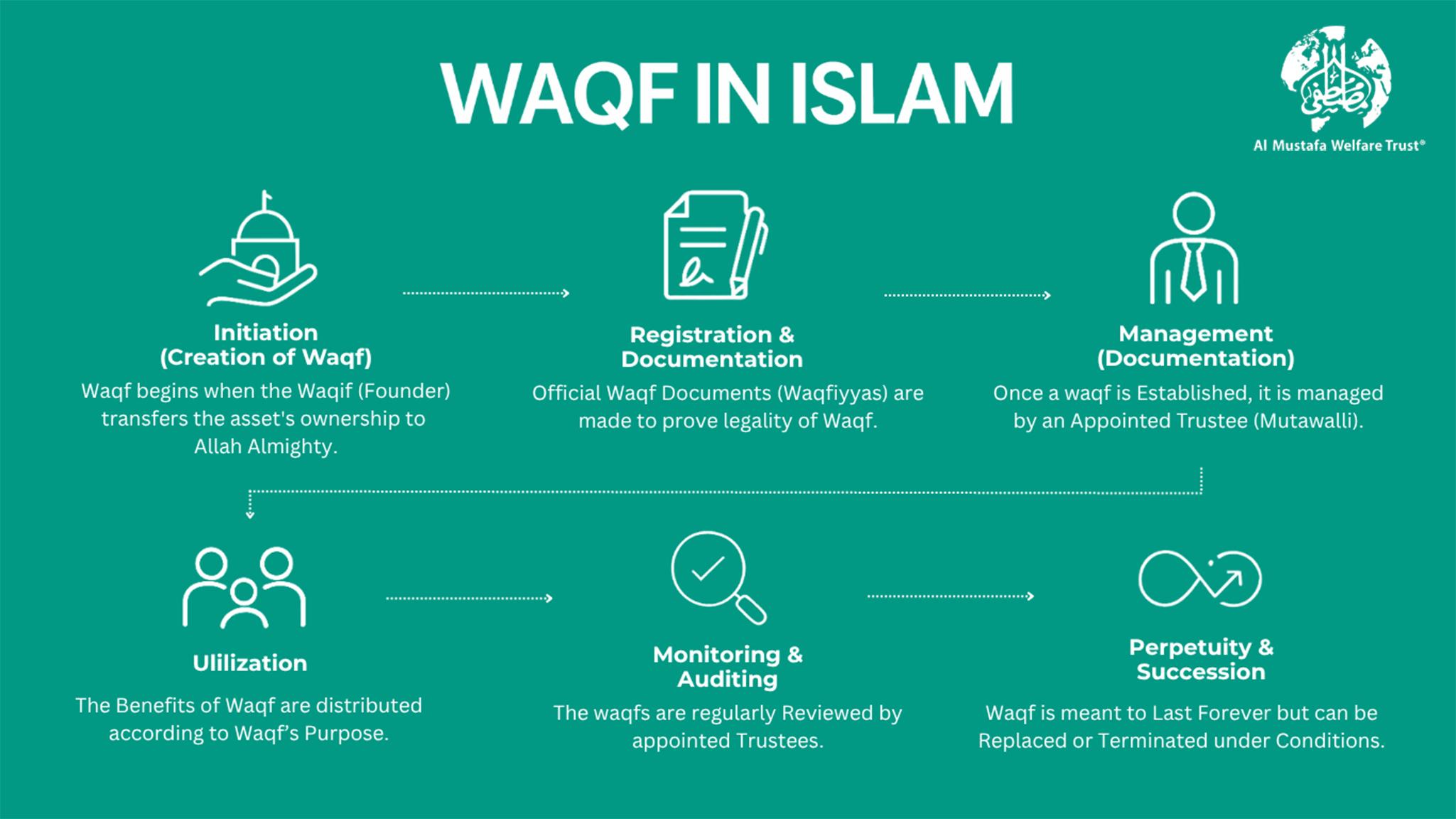
Waqf follows a legal and ethical process from creation to perpetuity, involving declaration, management, utilization, and monitoring. Let's walk through the full lifecycle of a waqf, from its inception to ongoing impact: Initiation (Creation of Waqf) The process begins when the waqif (founder) permanently donates an asset. This is a formal, irrevocable declaration, often made in writing, with witnesses. Once declared, the asset belongs to Allah Almighty, not the founder or their heirs. Registration & Documentation Official waqf documents are required to prove legality of waqf. These documents are called "Waqfiyyas". A waqf deed typically includes: • Full description of the asset • Boundaries and size, preventing ownership disputes • Share/fraction (if part of a larger property) • Intended beneficiaries • Specific terms (if it's for a fixed cause or limited time) Waqfiyyas are drafted using Islamic legal principles, ensuring they align with both civil law and Shariah. Management (Administration) Once established, the waqf is typically managed by an appointed trustee called a Mutawalli, Nazir, or Qayyim. This person or committee is responsible for: • Maintaining the asset • Ensuring benefits are distributed as intended • Reporting finances to relevant authorities The Mutawalli must be: • Trustworthy and financially capable • Legally competent • Independent of personal gain from the waqf (unless specifically permitted) In smaller waqfs, the founder may choose to manage it personally during their lifetime. Utilization The benefits of the waqf such as rental income, crops, or services are distributed according to the waqf's purpose. Typical waqf beneficiaries include: • Family members (in Family Waqf) • Students, widows, travelers, or orphans • Institutions like mosques, clinics, or schools Rules around beneficiaries: • Must be identifiable • Must not be at war with the Muslim community • Cannot violate Islamic principles Monitoring & Auditing Modern waqfs require financial transparency and ethical oversight. Many waqfs are now monitored by: • Local religious authorities (e.g., Awqaf councils) • Charity commissions • Internal boards with legal auditors This regular monitoring ensures: • Funds are not misused • The waqf remains within Islamic boundaries • Community trust is maintained Perpetuity & Succession Waqf is meant to last forever but under some conditions a waqf must be replaced (istibdal) or even terminated: • If the asset is destroyed or becomes unusable • If the waqf violates Islamic ethics or becomes corrupt • If a court rules it unlawful or unfit for its purpose In such cases, scholars may approve: • Replacing the asset with another (Istibdal) Islamic schools vary here: • Maliki school allows waqf to expire based on predefined conditions. • Others insist on complete perpetuity unless termination is unavoidable.
A valid waqf must meet Islamic legal, ethical, and property requirements including
A most common question that is often asked is "Who can create a Waqf?". The answer is that a person • Must be an adult of sound mind and legally competent. • Capable of managing financial affairs • The waqif must have full and undisputed ownership of the property or asset. • Must fully own the asset (i.e., not rented or borrowed) • Must declare the waqf voluntarily, forced endowments are invalid • Doesn't need to be a Muslim (even non-Muslims e.g., dhimmis) have also created waqfs under Islamic law) Note: If you're terminally ill (on deathbed), Islamic rules limit how much of your wealth you can donate, usually up to 1/3 to non-heirs (like charity, waqf, or friends). The remaining 2/3 must go to their rightful heirs, as defined in the Quran (children, spouse, parents, etc.).
• The purpose must be clearly defined: e.g., mosque maintenance, orphan support • Cannot be left to "future decision" without naming beneficiaries • Beneficiaries must exist or be foreseeable (e.g., future students of a school) • Must align with Islamic values, not support unlawful or unethical causes
Must be halal (lawful) in origin and use • Preferably immovable property (land, building) • Some scholars allow movable assets like tools, livestock, or money • Asset must have clear documentation, boundary descriptions, and value • Cannot include government property, stolen land, or haram items
Irrevocable: Cannot be canceled or reclaimed once declared • Unconditional: No "trial periods" or retractable clauses • Must be backed by a waqfiyya document, or equivalent legal deed Following these ensures your waqf is accepted legally, ethically, and spiritually,with full Waqf Rules compliance.
There are three ways to contribute: • Start your own waqf: even a small flat or savings fund can serve others. • Donate to a waqf project: water wells, schools, food programs. • Partner with Islamic charities running trusted waqfs like Al Mustafa Welfare Trust. You're not just donating, you're planting a seed that grows every day
While Sadaqah and Waqf are both forms of charity in Islam, they serve different purposes and operate in distinct ways.
| Feature | Sadaqah | Waqf |
| Nature | Voluntary and one time charity | Permanent and Ongoing Endowment |
| Duration | Temporary | Sadaqah Jariyah |
| Ownership | Transferred to Recipient | Transferred to Allah, only benefits are used |
| Management | No ongoing oversight needed | Managed by a trustee (Mutawalli) |
| Examples | Giving money or Food | Donating land or building a clinic, school, well etc |
Life is short. But your impact doesn't have to be. Contribute by donating through Al Mustafa Welfare Trust today for a waqf to help needy people now and in the future, and you will gain perpetual rewards that continue to grow even when you're gone.
What is a Waqf in Islam?
A Waqf is a gift of property or assets given permanently for a social welfare cause and to gain spiritual rewards. Its ownership will be transferred to Allah Almighty.
How does Waqf differ from regular charity?
Unlike one-time donations, a Waqf is a continuous charity that keeps helping needy people, even after your lifetime.
Who can establish a Waqf?
As long as you are an adult of sound mind and you own the asset and whether you are Muslim or non-Muslim, you can set up a Waqf if it's for a permitted, charitable purpose.
Can a Waqf end or be changed?
Yes. If an asset is damaged or becomes unusable, scholars may approve replacement (istibdal). Some schools of thought permit eventual termination if all beneficiaries no longer exist, but generally, waqf stays active as long as possible.
How can I support a Waqf?
You can create your own Waqf, donate to existing ones (like building wells or schools), or join Islamic charities running trusted waqfs like Al Mustafa Welfare Trust. Every contribution becomes Sadaqah Jariyah and brings lasting rewards for you.
What are the Types of Waqf in Quran?
There are 3 types of waqf in the Quran: Family waqf, Charitable waqf, and Public waqf. Each waqf serves different purposes and different types of communities.
Can anyone create a Waqf or is it only for the wealthy?
Anyone, whether he or she is wealthy or unwealthy can participate in or create a waqf, even if it's something small. What matters is that it's done for the sake of Allah Almighty and benefits others continuously.
What is the difference between Waqf and Zakat?
Waqf is a permanent charitable endowment for ongoing benefit, while Zakat is an obligatory annual charity based on one's wealth.